
Reference
Analysis and contract messages
What the analysis of an Arazzo file and the check of a contract report, what each message means and what to do about it.
Luvin checks your files without running anything. It reads the Arazzo file and reports what is missing, wrong or risky. It does the same for a contract you edit. This page lists those messages and what to do with each.
Where you see them
Section titled “Where you see them”| Where | What it shows |
|---|---|
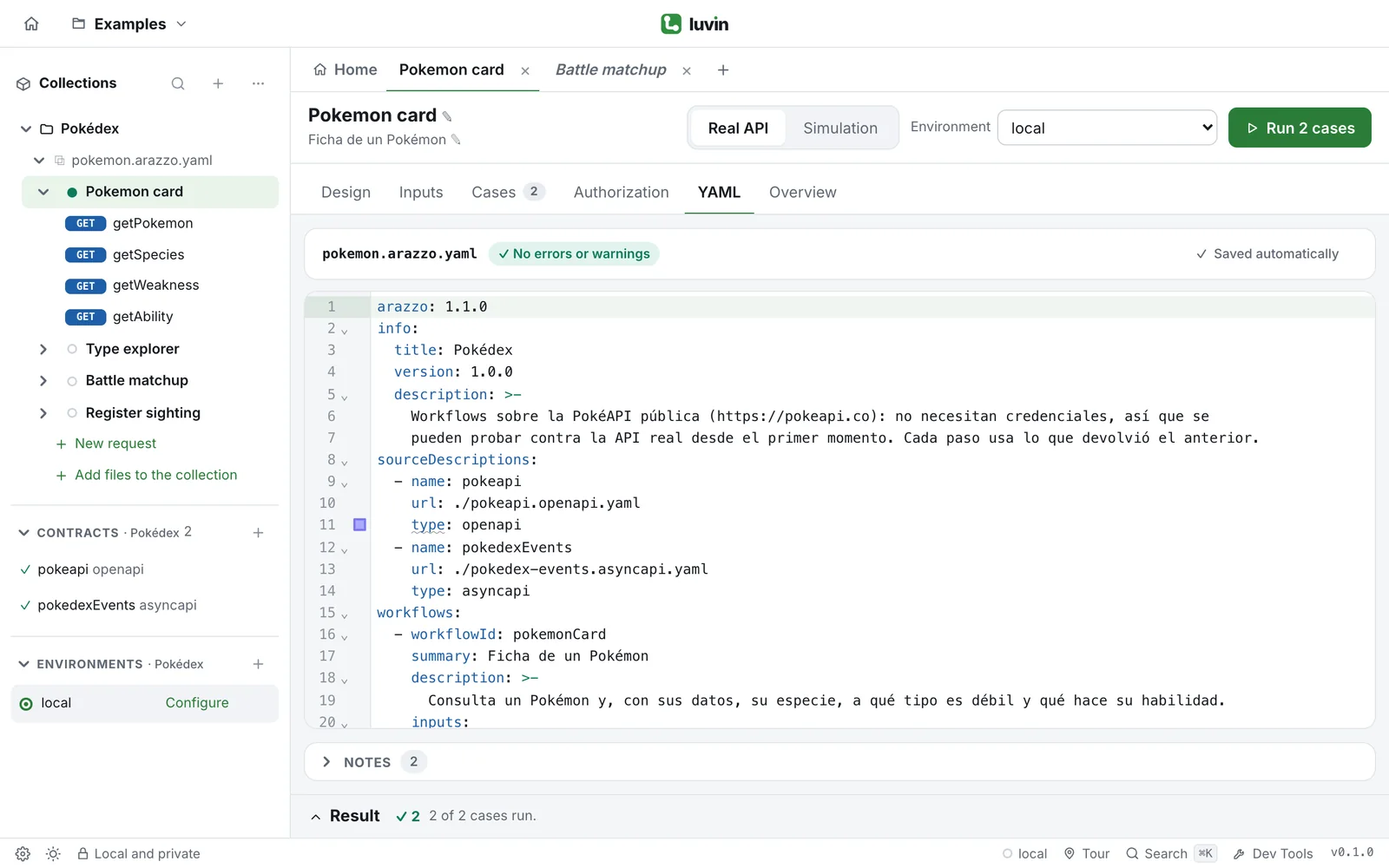
| The YAML tab | The bar says how many errors and warnings the file has. Each problem is underlined and listed under the text in Problems. Notes with information only are listed in Notes. Click one to go to its line. |
| The Overview tab of a workflow | General validation for the whole file and Workflow validation for the open workflow. |
| A step | The problems of that step, in its panel. |
| The editor of a contract | Each problem is underlined in the YAML of the contract and listed above the preview, with its line. |
Every message has a level.
| Level | Meaning |
|---|---|
| Error | Something is wrong and the workflow, or a step, will not work. |
| Warning | It may work, but it is probably not what you want. |
| Info | A note. Nothing is wrong. |
Messages about the Arazzo file
Section titled “Messages about the Arazzo file”The file and its contracts
Section titled “The file and its contracts”| Message | Level | What to do |
|---|---|---|
| Arazzo version “2.0” not recognized; 1.x is expected. | Warning | Set arazzo: to 1.0.1 or 1.1.0. |
| The Arazzo is version 1.2; Luvin supports up to 1.1, so some new fields may be ignored. | Warning | Expect that some fields do nothing. |
| info.title is missing in the Arazzo document. | Warning | Add a title under info. |
| The Arazzo does not declare sourceDescriptions. | Error | Add the contracts the workflows use. |
| The contract for source “x” (url) is missing. | Error | Add the contract file to the collection. See Contracts. |
| Source “x” is of type “arazzo”; only OpenAPI and AsyncAPI contracts are executed. | Warning | Use an OpenAPI or AsyncAPI contract. |
| “x” references files that were not loaded: … Upload them with the contract to resolve those $refs. | Error | Add the missing files. See Remote contracts and references. |
| The Arazzo has no workflows. | Error | Create a workflow. |
| Duplicate workflowId: “x”. | Error | Give each workflow its own id. |
| There are AsyncAPI steps. Luvin does not connect to brokers … yet, so those steps are always simulated … | Info | Nothing. See Messaging steps. |
| Source “auth” is another Arazzo document (auth.arazzo.yaml): its workflows can be used as $sourceDescriptions.auth. |
Info | Nothing. See Workflows that use other workflows. |
| Before this workflow, “a” runs (dependsOn); its outputs are available as $workflows. |
Info | Nothing. |
| The reference … does not exist in components. | Error | Create the reusable or fix the name. See Reusables. |
Steps and operations
Section titled “Steps and operations”| Message | Level | What to do |
|---|---|---|
| Duplicate stepId: “x”. | Error | Give each step its own id. |
| Each step must have exactly one of: operationId, operationPath, channelPath or workflowId. | Error | Keep one of the four. |
| Operation “x” does not exist in the loaded contracts. | Error | Fix the operationId or load the contract. |
| “x” is not the standard Arazzo form. It was resolved as GET /pokemon/{name}; change it to “$sourceDescriptions.pokeapi.getPokemon”. | Warning | Use the form it proposes. |
| “x” exists in several sources; “pokeapi” is used. | Warning | Use $sourceDescriptions.<source>.<operationId>. |
| The operationPath points to a path that does not exist in the contract; it was resolved as … | Warning | Remove the server prefix from the path, as the message says. |
| The operation for operationPath “x” was not found. | Error | Fix the path. |
| Channel “x” was not found in any loaded AsyncAPI. | Error | Load the AsyncAPI contract or fix the channel. |
| Channel “x” has more than one operation; the “send” one is used. | Warning | Write action: send or action: receive on the step. |
| Sub-workflow “x” does not exist. | Error | Fix the workflowId. |
| The step says “action: send”, but the AsyncAPI operation is “receive”. The step value is used. | Info | Check which one you want. |
| “action” and “correlationId” only apply to AsyncAPI steps; they are ignored on an HTTP step. | Warning | Remove them. |
| “correlationId” only applies to receive steps; it is ignored on a send. | Warning | Remove it. |
| A receive step sends nothing: its requestBody is ignored. | Warning | Remove the body. |
| Receive step without “timeout”: with a real broker it would wait for the message forever. | Info | Add a timeout. |
| Only “in: header” parameters are sent with a message; these are ignored: … | Warning | Move them to headers. |
Data between steps
Section titled “Data between steps”| Message | Level | What to do |
|---|---|---|
| Uses $steps.a.outputs.id, but step “a” does not exist. | Error | Fix the step id. |
| Uses an output of “a”, which runs later. | Warning | Move step “a” before this one. Steps run in order. |
| Uses $steps.a.outputs.id, but “a” does not declare that output. | Error | Add the output to step “a”. See Outputs. |
| Uses $inputs.x, which is not defined in the workflow inputs. | Warning | Add the input in the Inputs tab. |
| The contract requires the query parameter “x” and the step does not send it. | Warning | Add the parameter. See Parameters and body. |
| The contract requires a body and the step does not define requestBody. | Warning | Add a body. |
| An “in: querystring” parameter cannot be combined with “in: query” parameters on the same operation. | Warning | Keep only one kind. |
| This step sends cookies: the desktop app sends them, but the browser does not allow it and skips them. | Info | Use the desktop app to run it. |
Criteria, errors and dependencies
Section titled “Criteria, errors and dependencies”| Message | Level | What to do |
|---|---|---|
| No successCriteria: any 2xx response will be considered successful. | Info | Add a criterion if you need a stricter check. See Success criteria. |
| successCriteria is empty; Arazzo 1.1 requires at least one criterion when it is declared. | Warning | Add one, or remove the empty list. |
| The successCriteria expect 200, but the contract of GET /x only documents 404. | Warning | Align the Arazzo and the contract. |
| In … there are 2 $statusCode == conditions (200, 201). Arazzo requires all of them to hold at once, so they will never be met. Merge them into one: “…” | Error | Use the merged condition the message gives you. |
| 1 condition(s) are marked as “type: jsonpath” but are simple conditions … | Warning | Remove type: jsonpath and context from them. |
| Action “x” points to the non-existent step “y”. | Error | Fix the target of goto. |
| Action “x” (retry) points to the non-existent step “y”. | Error | Fix the stepId of the retry action. |
| Action “x” points to the workflow “y”, which cannot be found. … | Error | The sentence at the end says why. Fix the workflowId of the action. |
| “ref” is not a reference to another Arazzo document. | Error | Write the reference as $sourceDescriptions.<source>.<workflowId>. |
| “ref” uses the source “s”, which this Arazzo does not declare in sourceDescriptions. | Error | Add the source. |
| “ref” uses the source “s”, which is of type “openapi”: to call a workflow of another document the source must be of type arazzo. | Error | Set type: arazzo on the source. |
| “ref” points to ./auth.arazzo.yaml, which is not in the collection: add that Arazzo file. | Error | Import the file into the same collection. |
| “ref”: the workflow “w” does not exist in auth.arazzo.yaml. | Error | Fix the workflow id. |
| Action “x” is of type goto and defines retryLimit/retryAfter, which only apply to type: retry. | Warning | Remove those fields. |
| dependsOn mentions step “x”, which does not exist in this workflow. | Error | Fix the name. |
| dependsOn mentions “x”, which runs later. … move it after “x”. | Warning | Move the step. |
| dependsOn mentions “x”, but workflow “y” does not exist. | Error | Fix the name. |
The analysis also shows a Response coverage table: for each response the contract documents, whether the workflow handles it. See Success and errors.
Messages about a contract
Section titled “Messages about a contract”These come from the editor of an OpenAPI or AsyncAPI contract. They tell you what to fix in the contract.
| Message | Level | What to do |
|---|---|---|
| The $ref “x” doesn’t point to anything in the contract. | Error | Fix the reference. |
| The info section is missing (contract title and version). | Warning | Add info. |
| info.title is missing. / info.version is missing. | Warning | Add it. |
| This is Swagger 2.0: Luvin works with OpenAPI 3.x; consider migrating it. | Warning | Convert the contract to OpenAPI 3. |
| OpenAPI version “x”: 3.x is expected. | Warning | Set openapi: 3.0.3 or similar. |
| No servers defined: the base URL comes from the environment. | Info | Nothing, if the environment has the base URL. |
| The paths section is missing: the contract has no operations. | Error | Add paths. |
| The path “x” must start with /. | Error | Add the /. |
| The operationId “x” is repeated: an Arazzo won’t know which one to use. | Error | Give each operation its own id. |
| GET /x has no operationId: the Arazzo will have to use operationPath. | Info | Add an operationId. |
| GET /x doesn’t document any response. | Warning | Document at least the success response. |
| “x” isn’t a valid response code (use 200, 4XX or default). | Warning | Use a code, 4XX or default. |
| Incomplete parameter: it needs name and in (query, header, path or cookie). | Error | Fill both fields. |
| The path parameter “x” must have required: true. | Error | Set required: true. |
| The path parameter “x” doesn’t appear in “/y”. | Error | Remove it or add it to the path. |
| GET /y uses {x} in the path but doesn’t declare it as a parameter. | Error | Declare the parameter. |
| AsyncAPI version “x”: 2.x or 3.x is expected. | Warning | Use a supported version. |
| The channels section is missing. | Error | Add channels. |
| The operation “x” needs action: send or receive. | Error | Add action. |
| The operation “x” needs a channel with a $ref to a channel. | Error | Add the reference. |
When you change a contract that workflows use, the editor also lists the new problems that your change causes in those workflows, under Impact on workflows. See Edit a contract.